| |
Fast Glass (11/16/08),
anyone who's known me for more than four years knows I've always been
a Nikon guy (Nikon FTn, 1971, too many to count since then). There
are places I can turn up with my Canons and earn doubletakes. The point
being that I have decades worth of good glass that hasn't seen a lot
of duty lately. This is about to change. Here's why:
- Live View on the 50D finally lets me focus my older
fast lenses; the combination of the small viewfinder in digital cameras
using APS sensors, aging eyes, and manual focus is not a happy one.
- The sensor cleaning feature means I don't need to
be (as) reluctant to change lenses which is required when using
this glass because all my fast Nikkors are primes rather than zooms.
- I have a weakness for available darkness (which
is why I switched to Canon in the first place).
I got out of line for a 5DII in part because
the 50D was way cheaper and offered many of the advantages I wanted.
What I expect to want most from an eventual upgrade is another significant
step forward in terms of long-exposure and high-iso noise performance
(those two are not the same thing, but they're related). So I wanted
to see whether my cabinet of old, fast glass could give me a stop or
two advantage the old-fashioned, pre-digital way: put more light on the
sensor instead of pushing quantum physics into places no mortal has ever
been. Also, it will be good to see if the Nikkors work really well or
only sorta well when I use them more on the Canon bods, because it will
be much less onerous to trade up to a full-frame kit if I know I can
buy appropriate Canon glass over time rather than all at once (buy the
24-105, for example, and count on my 15mm F5.6 Nikkor to fill in the
short range for the time being...). So my motivations are multiple. What
else is new?
First impression: with a handful of $15 adapters,
these lenses work just fine on my AP-S sized EOS. I expect that they'll
work just fine when I eventually go to a full-frame Canon (or back to
Nikon, for that matter). I've had these adapters for a while and used
them rarely. The telephotos didn't see much use until Live View and a
high-fidelity LCD came along to help focus them, and the 24mm never saw
much use because the 17-85mm and 10-22mm Canon EF-S zooms covered much
of its capability (except handheld or with moving subjects in the dim).
The extended range of practical ISOs on the 50D has renewed my interest
in shooting with the lights down low (extended compared to my 20D --
the difference seems stark in practice and I am puzzled by the fact that
objective noise measurements do not bear out this impression; there's
more at work here than meets the metric).
All these lenses benefit from the small,
AP-S sized sensors in Canon's midrange cameras: the telephotos see only
a center-cut filet of what was already impressive performance, and the
24mm vignettes less at full aperture than it did on my 35's.
The lenses:
24mm F2.0 "Back
in the day" this was my walkin' around lens. I bought it used at
the Kingsport Camera Shop for about 30 cents on the dollar compared to
new (that's about the bargain ratio of all my fast glass, except that
the others came from eBay; KCS became a Ritz years ago). From the day
I bought it, this lens lived on each of my Nikons. I had to have a damn
good reason to take it off. Today I've been "walkin' around"
in a darkened house being amazed at what high-ISO life is like at F2.0.
The jury is still out on its real-world performance on the EOS. It
was never a razor sharp lens wide open, but it was fast and it was
sharp enough. It was not pristine when I got it, and it's been banged
around a lot over the years. Wide-angle AF zooms were too easy to leave
in place especially when Image Stabilization makes up for some of the
optical speed difference. With moving subjects, ultrasonic automatic
sensor cleaning to make lens-swapping more palatable, and a high-res
CMOS detector begging for low-light projects, I'm anxious to see what
this old soldier can do.
135mm F2.0 It's razor sharp, but
it was damned hard to focus on the earlier EOS's. The very slightly
larger viewfinder in the 50D makes a significant difference with
this lens, and Live View makes it easy to get its best performance.
I suspect it has found a new home as a handheld lens ready to capture
charming details in selective focus at dimly lit events.
 |
200mm
F2.0 Even when I used this lens on my 35mm Nikons (think
bright, full-sized viewfinders with split-image prisms), I rigged
up a micrometer to help find best focus. Nothing I did in the
APS world (including putting a split-image prism in my EOS) made
it practical -- why haul what feels like 25 pounds of glass just
to shoot fuzzy pictures at very fast shutter speeds? When it's
exactly focused, it's unholy sharp, but it practically never
is. Until now. Put it on a tripod (of course you're going to
put it on a tripod; just look at this thing!), and gross focus
with the focus ring. Crank up Live View. Zoom in to 10x, tweak
with the micrometer and Kazango! Every time. It's not
for action with that kind of meticulous manual focus required,
but given a subject that stays put (birds in trees, cats on mats,
brides at altars) you are not going to get a sharper, brighter
image from anything. Put a 2x extender on it, and you have the
35mm equivalent of a 640mm F4. In that configuration, it's just
as easy to focus as the 200mm F2.0 (a sentiment which until the
50D and Live Vew was a cruel joke).
<< The photo at left
is an average of 11, 45-second exposures of M45, the Pleiades,
rising above pines near Rutherford College, NC. Nikkor 200mm
ED F2.0 at F2.8, ISO 1600, aligned and averaged in Maxim DL,
finished in Photoshop CS4, tracked (unguided) on a Losmandy
G11 mount.
As usual, star tests quickly reveal
problems which earthly uses forgive. The cheap-jack Nikon to EOS
adapters do not hold the Canon body tight and exactly square. The
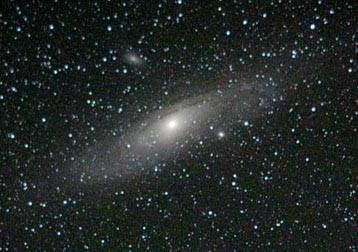
crop from a photo of M31 below shows much fatter stars at the top
of the frame than at the bottom. Something needs shimming or spring-loading
for this application. (On Earth as it is not in heaven: in the
terrestrial sphere, I expect to be using the lens for selective
focus, so 99% of the time it matters not at all if lovely, defocused
light and color fill part of the frame.)
M31, same tech specs as M45, except
only 3 frames totalling just 135s exposure. Among other issues,
this subject needs a far longer exposure to clean up noise made
evident by my leaning on this image way too hard:
What works for a telephoto
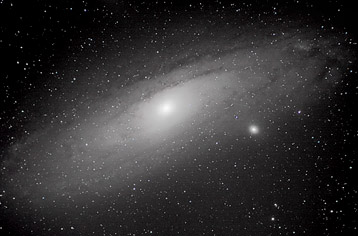
works on a telescope: the next night, I used the 5-inch F6
Astro-Physics refractor and exposed for a total of just 7.5
minutes (10 x 45-seconds @ iso 1600). This frame, too, has
been aggressively processed. The 50D is promising. (The original
image has hundreds of times more info than the thumbnail below.
Just stay tuned.)
|
55mm F1.2 Mine
is not the 58mm Noctilux version of Nikon's fast fifty, and it's just
not sharp anywhere near wide open. Never was. It's always been a disappointment
because I had big hopes for it. Close it down to F4 or F5.6 and it's
fine, but who cares? That's not what that lens is for. I hoped for a
miracle when I adapted it to a small-sensor EOS, but I did not get one.
I took it to a wedding rehearsal dinner for one last chance. It delivered
wonderfully fast exposures, great tones, but useless, unpredictably fuzzy
images. Not soft-focus, which can be nice, but simply, uselessly out-of-focus.
I bought a new 50mm F1.8 Canon AF for a fraction of the Nikkor's
used price and am much happier with that; the stop or so disadvantage
is made up many times over by the sharpness and convenience of the
modern lens.
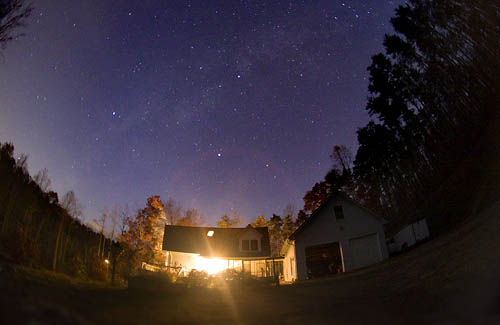
Kay and Patrick Crouch's home,
Ticknock, at night,
8mm Peleng, F3.5, 30s, iso 3200
8mm Peleng
Fisheye. It's not fast glass, but it gets a paragraph here anyway
because I wouldn't have tried it out if I weren't on this old-lens
jag. I had to make an adapter for it since it wouldn't reach focus
with a Canon lens mount that came with it. Why? Who knows. All it took
was a spacer (the world's shortest extension tube) interposed between
the stock EOS adapter and the lens body. I turned one from a big hardware
store washer using an antique lathe. I shaved it thinner and thinner
and repeatedly inspected the image in live view; iterate until the
lens actually focused where it said it focused. The photo above is
a test under the stars. (I could've done this conversion by inspecting
captures in Photoshop but the fact is that I just never bothered. The
50D's live view and honest-to-goodness useful viewing screen made the
project much more attractive.) The required extension turned out to
be 0.020 inches. Using this lens is great sport. It is not without
issues. But, hey, it's mostly a toy except under the right, very
special circumstances, and then nothing else will do.
55mm F3.5 Micro-Nikkor This
is not fast glass either, but it's going to be fun to put this legendary
glass back to work. I should've been using this all along, since nothing
has changed to make it less useful today than it was yesterday. Detail
from a US nickel, reverse:

[Addendum,
11/18/08: But... at the end of the day, rather than mess with
the 135mm F2 and the 200mm F2, would I rather just buy a 70-200mm F2.8
IS Canon zoom? That's the way I'm leaning after another day of walking
around irritating the cats by clicking at them while they sleep, bathe,
walk, fight, play, and otherwise provide lens-testing fodder. Day before
yesterday was all about fast, fixed, manual-focus lenses -- he-man
Magnum Life Black Star straight-shifting muscle-car photojournalist
glass -- and today I've been using the 70-200mm F4 plain jane Canon
for comparison. And you know what? Crank the ISO to 2000 and let autofocus
take care of sharpness, breathe carefully, shoot straight... and the
results are usually just about as good or better. So I'm thinking a
good investment would be the faster, image stabilized version of that
lens. IS to stop my shake; a stop faster to help stop subject motion....
is this a case of taking back in the footnotes most of what's been
said in the text? We'll see.]
:: back to
the slow blog ::
|