|
Wave 100i 101.
(Packing list 001: battery, power cable, handset, mount, alignment block, iPhone, R6, 400mm, Bahtinov mask, flashlight, reading glasses.)
9/03/2026. Still too ambitious. I fell asleep on the couch yesterday and awoke too late to get out, set up, and get anything good before Moonrise. And today we expected the countertop people at 8:00 AM (they did a great job starting about 3:00 PM, miscommunication somewhere), so it's just been too long a day on too little sleep to mess with a potentially frustrating project. On the up side, late last night I solved the "what to do with the SynScan V handset" problem with a bit of aluminum, some Velcro, and a durable bit of cord. Use the cord to hang the aluminum strip on the tripod, attach Velcro to the aluminum and to the handset, and voila!. If things get out of hand and I run out of slack in the handset's cord somehow, the Velcro becomes a weak link to keep the torque of the strain wave mount from bending, denting, breaking, or otherwise deforming anything important.
9/04/2026. I woke up this morning thinking, "What's wrong with you? The only thing that belongs on that upper spar is the imaging OTA and sensor train." The guide-scope and the mini-computer can ride the lower spar together. Polar alignment hardware -- either the iPolar kit or some DIY iPhone brackettry -- can be mounted temporarily in place of the imaging gear as needed, which will be at most once at the beginning of any given night. I could have a drop dead simple rig for widefield imaging and store the mini-computer and guide-scope on a dedicated second spar to be mounted only when needed (such as, for example, when using longer exposures through narrow-band filters and/or with longer focal length lenses and 'scopes). It would be much better for solar imaging because no secondary scopes would need to be capped/protected. I took apart last spring's ill-considered mess and cobbled up a revised kit after supper. It needed only an extra threaded hole in one mounting bracket to work out just as imagined. Done. Why was this so hard to see? (Where's the catch?) Now, bring on autumn's clear and cooler skies.
9/07/2026. Dry runs on the porch reveal an intermittant problem with slewing in declination: the mount will always slew north but is sometimes reluctant to slew south. Pressing another key first ("objects" for example) will often "wake up" the south button, but even that seems less than fully reliable. I do need to update the firmware (the latest version permits dual control, the handset and the app which would be great), but that evidently requires the handset to be connected to the mount and via USB. Maybe there's a fix in there somewhere. Maybe I need to clean contacts. Maybe, maybe, maybe. Let's save that for another day. In the meantime, today (the 7th) declination is working properly. Wait for some actual sky trieals before pursuing a fix.
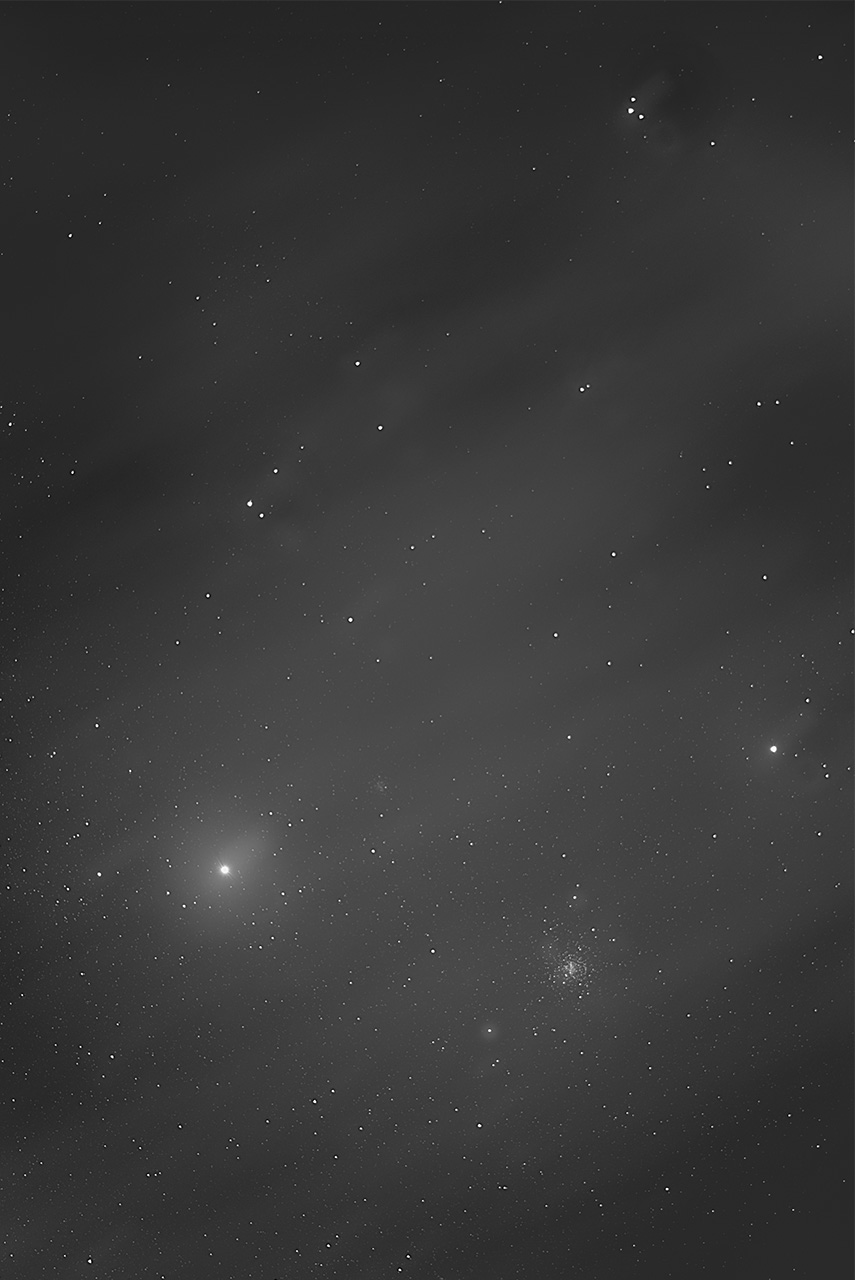
9/13/2026. Sometimes you just have to set up the 'scope, open the shutter, and see what you get. The forecast has been teasing clear evenings day after day and this is as close as my sky has come to cooperating. Which is not very. The photo is not much, but now we know that the little strainwave mount will carry the 400mm Nikkor for 30-second unguided sub-exposures very nicely and that an iPhone app for blind polar alignment is good enough at that modest focal length. All in all, that's enough to prove the usefulness of a very convenient rig for a clear, dark night -- assuming one is available eventually.
The sky really didn't cooperate, but the mount worked perfectly. The iPhone app (Polar Scope Align Pro) worked well for a blind polar alignment using only the iPhone 14's internal orientation sensors -- as if I couldn't see Polaris and the truth is, I never looked. (I need to remember to reset the UT offset in the hand controller to -5 hours from -4. And devise a finder. And damn, the viewpoint is low to the ground, even for this subject.) I made an implicit faux-flat from one of my lights within PixInsight using hints found by Googling that very idea. AI may be the death of us all, but we'll get some good pictures first. To make a synthetic flat, first produce a starless version, then apply a Multiscale Median Transform using only the largest-scale "residual" layer to blur the result. Note that if you specify 5 layers, the residual kernal is 32 pxels; 6 layers, 64 pixels. Try 7 or 8 layers for 128 or 256 pixels. I could have but did not clone out a couple of remaining star signals before applying the MMT. This worked very well as a flat, aided in part perhaps by the roughly 150 pixel drift during the hour-long exposure which minimized the localized effects of the imperfectly removed image of Antares. Promising technique! I'm revisiting an adapter for a finder to be simply held against the tube of the 400mm. Parallel cylinders and aluminum angle stock will align the finder tube with the body of a large lens or telescope (or the Wave body, for that matter). It's an old notion finally finished with a key shower insight. It should be useful at least until I work out how to use precise go-to commands. I ordered angle "iron" from eBay. Amazon had it for less (same price, but more metal delivered sooner). I never guess correctly.
:: top ::
|
|
© 2026, David Cortner